Showing posts with label Natural Living How To. Show all posts

Tuesday, June 9, 2015

Essential Oils and Pets: A Quick How-To


If you love using Young Living products in your home, you’ve probably wondered how you can share their amazing benefits with your animals. Which oils are safe to use? How much can I apply? Should I diffuse or apply topically? 
If you’ve ever had questions like these, we’re here to help! Check out this quick-and-easy how-to guide for using essential oils with animals.* Whether you’re a beginner or an expert, here are a few things to keep in mind: 
Most animals are more sensitive than humans to essential oils.
  • Start by diluting heavily and use in moderation.
  • Every animal is different, so carefully observe how each animal responds to the oils. Use common sense and good judgment as you try different methods.
  • Take special care to not get essential oils in an animal’s eyes.
  • Avoid using high-phenol oils such as Oregano and Thyme with any animals, especially cats.
  • Use special caution when using essential oils with cats. Cats are also generally averse to citrus essential oils.

Pets-Animals and Essential Oils - Young Living

Your animal’s size affects the amount of oil you should use.
  • For smaller animals like cats and small dogs, use 3–5 drops. Be sure to dilute 80–90 percent prior to application (for example, for every 1 drop of oil, use 4–5 drops of a diluting agent, such as V-6Vegetable Oil Complex).
  • For larger animals, like large dogs, start with 3–5 drops. Unless otherwise indicated on the product label, dilution is unnecessary.
  • For very large animals, like horses and cattle, start with 10 drops. Unless otherwise indicated on the product label, dilution is unnecessary.

Apply oils to yourself or diffuse to introduce animals to essential oils and help them get comfortable.
  • Wear oils around your animals, diffuse in their space, or apply to your hands and let the animal smell them.
  • If your animal is jittery or resistant to essential oils, try applying an oil to yourself and staying near the animal for several minutes so it can get used to the aroma.
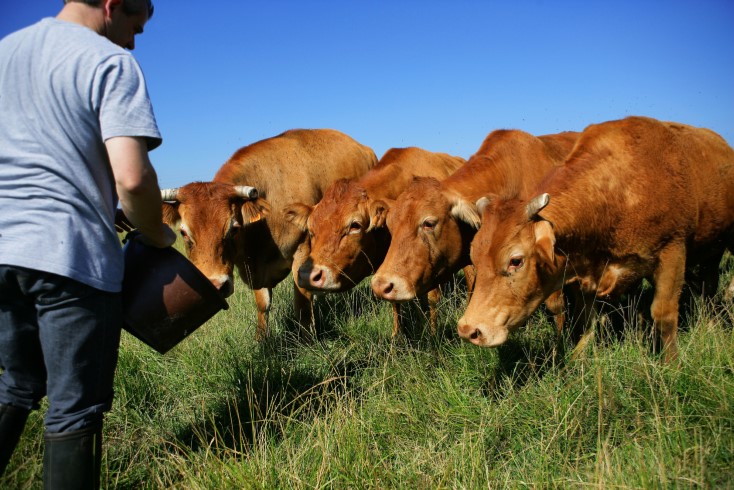
Cattle

Once they’re used to essential oils, animals can respond well to topical application.
  • For cats and dogs, paws are a great place to apply essential oils.
  • For hoofed animals, we recommend application on the spine or flanks.
  • Try rubbing oils onto your own hands and then stroking the animal’s fur.
  • For large or hard-to-reach areas, combine essential oils with V-6 Vegetable Oil Complex or water in a spray bottle for easier application.
  • Animal Scents Ointment can be used to seal and protect areas where essential oils have been applied topically.

Essential oils can be administered internally.
  • Some essential oils can be mixed with your animal’s food.
  • For large animals, you can pull out the bottom lip and drop oils directly into the mouth.

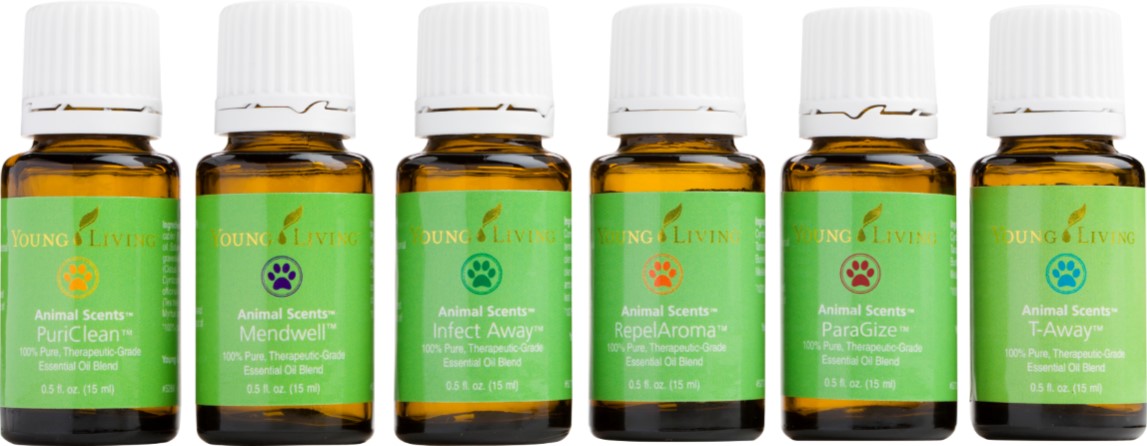
Young Living offers a full line of animal-specific products.

AnimalScents Oils - Young Living

*If your pet or animal has a known health issue, please consult your veterinarian before administering essential oils.

Get started on your amazing essential oils journey at:


Saturday, March 14, 2015

Top 10 Reasons Why Your Pets Should Take Fish Oil


Fish oil supplements are an ideal complement to your pet’s diet because they supply omega-3 fatty acids, which your dog or cat’s body cannot sufficiently produce on its own. Still in doubt? Here are the top 10 reasons why it’s important to supplement your dog or cat’s daily intake with a quality fish oil supplement.

1. Your Pet Will Burn Fat More Efficiently

The Omega-3 fatty acids in fish oil supplements help improve the metabolism of a dog and cat’s body in a natural way and cause body fat to burn more quickly. (2,10)

2. Improved Development of Puppies & Kittens During Pregnancy

During a pregnancy, supply your canine or feline mama omega-3 needs with a pure, safe fish oil supplement. The reason is because the omega-3 fatty acid DHA helps improve brain development, concentration, immunity and eyesight, among other things. (1,5)

3. Slow Down Your Pet’s Aging Process

We all want to age more slowly, right? EPA and DHA found in fish oil help slow down the aging process by reducing inflammation and extending the longevity of cells. In this way, omega-3s help keep your pet kids feeling younger for longer. (3)

4. Improved Flexibility

Because of the anti-inflammatory properties of EPA from fish oil supplements, the discomfort in your pet’s joints and muscles may actually decrease. What you will notice is that over time, fish oil supplements can help with stiffness to rise and help your pet be more active and enjoy walks and games with you. (4)

5. Improved Performance in Canine Athletes

Omega-3s in fish oil supplements improve the functioning of the lungs. For our active agility dogs, runners, Frisbee dogs, swimmers and mountain hiker companions, fish oil will help your dog keep up with you. (14)

6. Better Concentration & Limiting Brain Cell Deterioration

Thanks to EPA and DHA from fish oil, your pet’s brain may age more slowly and perform optimally. The essential fatty acids in the omega-3s contribute to sounder sleep, an essential element in keeping concentration sharp. (6)

7. Optimized Immune System Functioning

A daily supplement of omega-3s from fish oil supplements help the white blood cells perform their anti-inflammatory function optimally. This helps your pet’s defense against diseases and other ailments by strengthening the immune system. (15)

8. Better Heart Health

The omega-3s in fish oil supplements help keep cholesterol levels at a healthy level and help keep this vital muscle healthy. (8,9)

9. No More Grumpy Cat

Fish oil supplements are proven to improve mood in humans, and studies are forthcoming about their benefits in pets! (12, 13)

10. Healthy Skin & Shiny Coat

The benefits of omega-3s in fish oil supplements for skin health are well documented, but did you know that omega-3s also help protect against sunburn? (6,7)


Adding health-promoting fish oil to your pet’s diet can be one of the best decisions you make for your companion animal. If you want to learn more, visit our website!


References:

1. Zicker SC1, Jewell DE, Yamka RM, Milgram NW. Evaluation of cognitive learning, memory, psychomotor, immunologic, and retinal functions in healthy puppies fed foods fortified with docosahexaenoic acid-rich fish oil from 8 to 52 weeks of age. J Am Vet Med Assoc. 2012 Sep 1;241(5):583-94. doi: 10.2460/javma.241.5.583.

2. Xenoulis PG1, Steiner JM. Lipid metabolism and hyperlipidemia in dogs.Vet J. 2010 Jan;183(1):12-21. doi: 10.1016/j.tvjl.2008.10.011. Epub 2009 Jan 23.

3. Figueras M, Olivan M, Busquets S, López-Soriano FJ, Argilés JM. Effects of eicosapentaenoic acid (EPA) treatment on insulin sensitivity in an animal model of diabetes: improvement of the inflammatory status. Obesity (Silver Spring). 2011 Feb;19(2):362-9. doi: 10.1038/oby.2010.194. Epub 2010 Sep 30.

4. Moreau M, Troncy E, Del Castillo JR, Bédard C, Gauvin D, Lussier B. Effects of feeding a high omega-3 fatty acids diet in dogs with naturally occurring osteoarthritis. J Anim Physiol Anim Nutr (Berl). 2012 Jul 14. doi: 10.1111/j.1439-0396.2012.01325.x

5. Bauer JE, Heinemann KM, Lees GE, Waldron MK. Retinal functions of young dogs are improved and maternal plasma phospholipids are altered with diets containing long-chain n-3 polyunsaturated fatty acids during gestation, lactation, and after weaning. J Nutr. 2006 Jul;136(7 Suppl):1991S-1994S.

6. Bauer JE. Therapeutic use of fish oils in companion animals. J Am Vet Med Assoc. 2011 Dec 1;239(11):1441-51. doi: 10.2460/javma.239.11.1441. Review.

7. Popa I, Pin D, Remoué N, Osta B, Callejon S, Videmont E, Gatto H, Portoukalian J, Haftek M. Analysis of epidermal lipids in normal and atopic dogs, before and after administration of an oral omega-6/omega-3 fatty acid feed supplement. A pilot study. Vet Res Commun. 2011 Dec;35(8):501-9. doi: 10.1007/s11259-011-9493-7. Epub 2011 Jul 23. Erratum in: Vet Res Commun. 2012 Mar;36(1):91

8. Smith CE, Freeman LM, Rush JE, Cunningham SM, Biourge V. Omega-3 fatty acids in Boxer dogs with arrhythmogenic right ventricular cardiomyopathy. J Vet Intern Med. 2007 Mar-Apr;21(2):265-73.

9. Freeman LM, Rush JE, Markwell PJ.Effects of dietary modification in dogs with early chronic valvular disease. J Vet Intern Med. 2006 Sep-Oct;20(5):1116-26.

10. Laflamme DP. Understanding and managing obesity in dogs and cats. Vet Clin North Am Small Anim Pract. 2006 Nov;36(6):1283-95, vii. Review.

11. Brown SA, Brown CA, Crowell WA, Barsanti JA, Allen T, Cowell C, Finco DR. Beneficial effects of chronic administration of dietary omega-3 polyunsaturated fatty acids in dogs with renal insufficiency. J Lab Clin Med. 1998 May;131(5):447-55.

12. Hegarty B, Parker G. Fish oil as a management component for mood disorders - an evolving signal. Curr Opin Psychiatry. 2013 Jan;26(1):33-40. doi: 10.1097/YCO.0b013e32835ab4a7

13. Hegarty BD, Parker GB. Marine omega-3 fatty acids and mood disorders--linking the sea and the soul. 'Food for Thought' I. Acta Psychiatr Scand. 2011 Jul;124(1):42-51. doi: 10.1111/j.1600-0447.2011.01703.x. Epub 2011 Apr 11. Review.

14. Wakshlag J, Shmalberg J. Nutrition for working and service dogs. Vet Clin North Am Small Anim Pract. 2014 Jul;44(4):719-40, vi. doi: 10.1016/j.cvsm.2014.03.008. Review.


15. Hall JA, Henry LR, Jha S, Skinner MM, Jewell DE, Wander RC. Dietary (n-3) fatty acids alter plasma fatty acids and leukotriene B synthesis by stimulated neutrophils from healthy geriatric Beagles. Prostaglandins Leukot Essent Fatty Acids. 2005 Nov;73(5):335-41.