Showing posts with label Pets. Show all posts

Tuesday, June 9, 2015

Essential Oils and Pets: A Quick How-To


If you love using Young Living products in your home, you’ve probably wondered how you can share their amazing benefits with your animals. Which oils are safe to use? How much can I apply? Should I diffuse or apply topically? 
If you’ve ever had questions like these, we’re here to help! Check out this quick-and-easy how-to guide for using essential oils with animals.* Whether you’re a beginner or an expert, here are a few things to keep in mind: 
Most animals are more sensitive than humans to essential oils.
  • Start by diluting heavily and use in moderation.
  • Every animal is different, so carefully observe how each animal responds to the oils. Use common sense and good judgment as you try different methods.
  • Take special care to not get essential oils in an animal’s eyes.
  • Avoid using high-phenol oils such as Oregano and Thyme with any animals, especially cats.
  • Use special caution when using essential oils with cats. Cats are also generally averse to citrus essential oils.

Pets-Animals and Essential Oils - Young Living

Your animal’s size affects the amount of oil you should use.
  • For smaller animals like cats and small dogs, use 3–5 drops. Be sure to dilute 80–90 percent prior to application (for example, for every 1 drop of oil, use 4–5 drops of a diluting agent, such as V-6™Vegetable Oil Complex).
  • For larger animals, like large dogs, start with 3–5 drops. Unless otherwise indicated on the product label, dilution is unnecessary.
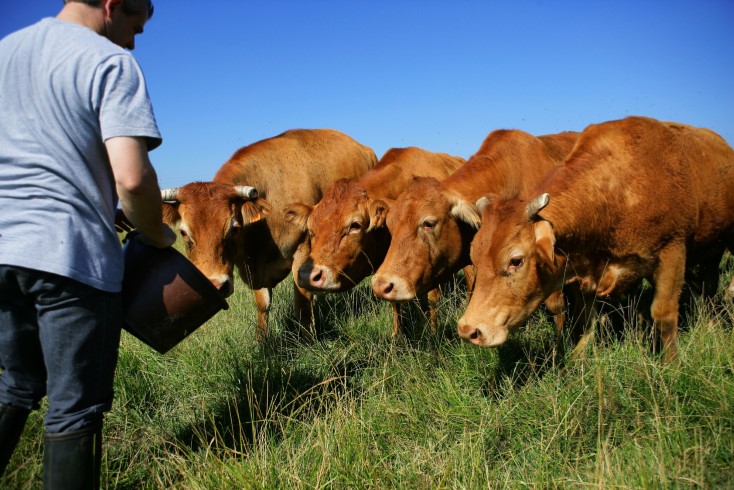
  • For very large animals, like horses and cattle, start with 10 drops. Unless otherwise indicated on the product label, dilution is unnecessary.

Apply oils to yourself or diffuse to introduce animals to essential oils and help them get comfortable.
  • Wear oils around your animals, diffuse in their space, or apply to your hands and let the animal smell them.
  • If your animal is jittery or resistant to essential oils, try applying an oil to yourself and staying near the animal for several minutes so it can get used to the aroma.

Cattle

Once they’re used to essential oils, animals can respond well to topical application.
  • For cats and dogs, paws are a great place to apply essential oils.
  • For hoofed animals, we recommend application on the spine or flanks.
  • Try rubbing oils onto your own hands and then stroking the animal’s fur.
  • For large or hard-to-reach areas, combine essential oils with V-6 Vegetable Oil Complex or water in a spray bottle for easier application.
  • Animal Scents™ Ointment can be used to seal and protect areas where essential oils have been applied topically.

Essential oils can be administered internally.
  • Some essential oils can be mixed with your animal’s food.
  • For large animals, you can pull out the bottom lip and drop oils directly into the mouth.

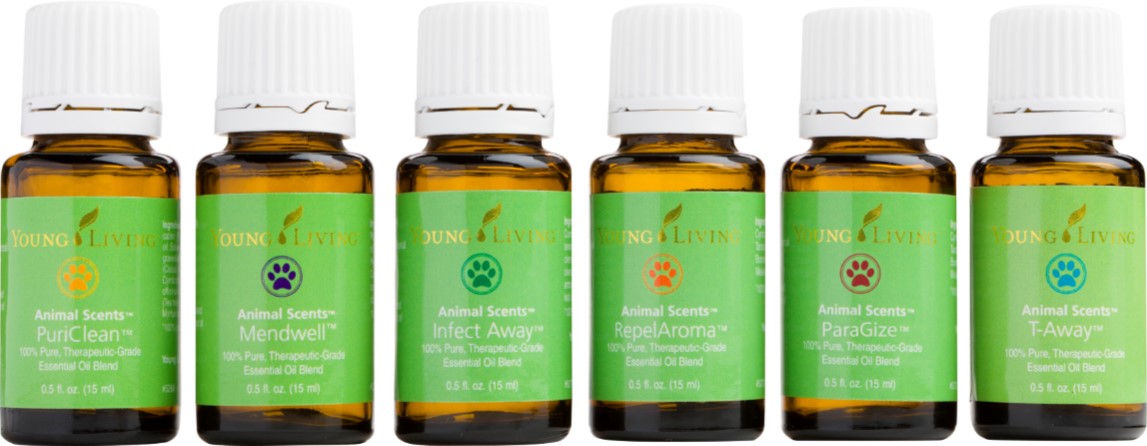
Young Living offers a full line of animal-specific products.

AnimalScents Oils - Young Living

*If your pet or animal has a known health issue, please consult your veterinarian before administering essential oils.

Get started on your amazing essential oils journey at:


Thursday, March 6, 2014

Pet Care 101: Holistic Veterinary Care


More and more pets are reaping the benefits of holistic veterinary care every day. Veterinarians are becoming frustrated with their patients not responding to the protocols that they were taught in veterinary school. As a result, many are continuing their education by taking classes in complementary modalities. These may include: Acupuncture and Chinese Medicine, Homeopathy, Chiropractic, and Flower Essence Therapy, to name a few.  Large and companion animal vets have embraced these new therapies. In wildlife and zoo animal medicine, homeopathy and flower essences are especially beneficial. This is because of their palatability, infrequent dosing requirements and the fact that they work so well in cases that have a strong emotional basis.


Of course domestic animals have their share of emotional issues also. One of the most rewarding aspects of obtaining a holistic veterinary education is the knowledge one acquires to be able to help in the area of grief. As in people, animals become sad and despondent with the passing of a loved one. Many times the holistic veterinarian will prescribe homeopathic remedies for grief.  A common scenario is:  two senior dogs, let's say Labrador Retrievers who are brothers, 10-12 years old. One becomes ill and dies. The remaining brother stops eating and loses his will to go on.  Most vets are not called until this has been ongoing for 1-2 weeks.  The pet parents are grieving and afraid they are going to lose their other senior boy. However, once they start giving one of the homeopathic remedies for grief (there are a few), within a day or two the remaining Labrador begins to eat, and he is no longer ill from being sad.

All types of animal patients benefit from holistic pet care. The conditions holistic vets see the most are: Arthritis, Allergic Dermatitis, Neurological Disorders, Cancer, and Autoimmune disease. However, emotional issues are common also, such as aggression, separation anxiety, dementia and fearfulness. As in people, often the physical symptoms of the diseases vets see are preceded or accompanied by emotional imbalances. Luckily, holistic veterinary medicine provides a myriad of treatment options for the few, but increasing, holistic vets who have had the good fortune to experience and learn these modalities.


*  *  *  *  *  *  *  *  *  *  *

To keep your pets healthier, happier, and living longer lives, we recommend feeding them our premium line of natural pet food, treats and supplements, as well as caring for them with our line of holistic pet care products.  All of our products are formulated by our holistic veterinarian, Dr. Jane Bicks, who works very hard to not only provide the best, health-promoting products . . . . Dr. Jane and Life's Abundance have also established a foundation to help improve the lives of abandoned companion animals all across the U.S.  Every time you purchase a Life's Abundance product, a portion of the profits are contributed to a fund that supports the operation of this organization.  Thank you so much for your continued business! Together, we are making a positive difference in the world, one animal at a time. 

*  *  *  *  *  *  *  *  *  *  *
Raven is an engaging entrepreneur who encourages others to celebrate pets as part of the family, as well as keep them happy, healthy, and spoiled with her online specialty pet boutique (http://www.TheGiftedPet.com), and premium pet food business (http://www.PremiumPetFoodStore.com)

For more information, please visit her Facebook page to PM her (https://www.facebook.com/TheGiftedPet), or email her at Raven@TheGiftedPet.com

Sunday, February 2, 2014

Heart Health for Humans and Pets


Heart Health Awareness Month is right around the corner, beginning February 1st. While technically concerned with human heart health, I think it’s vital that we expand the scope of the conversation to address canine and feline heart health, too.
Most people have a basic understanding of the risks of heart disease in humans, but when it comes to the heart health of our pet kids, that area remains a mystery to many.
In the following seven frequently-asked questions, we’ll consider the parallels between all three species (humans, canines and felines), to better understand heart disease.
How Widespread is Heart Disease?
Humans: In America, heart disease is the #1 cause of death. Annually, about 600,000 people die of heart disease, one in every four deaths.
Dogs and Cats: Although reliable statistics are not readily available for adult felines or canines, heart disease is not the pressing problem that it is for humans. That being said, heart problems are still common, with one in ten dogs developing valvular heart disease. As with many health issues, the risk for heart disease increases with age, especially for dogs over the age of nine (the age varies from breed to breed). When it comes to cats, tracking heart disease proves extremely challenging, as felines present virtually no physical symptoms from this condition.
What’s the Most Common Form of Heart Disease?
Humans: In adults, coronary artery disease is the most prevalent kind of heart disease. The main type involves plaque build-up in the arteries, which affects their ability to deliver blood to the heart. As the layers of plaque thicken and harden, blood flow to the heart is further restricted.
Dogs and Cats: The biggest difference here is that pet kids are not at-risk for coronary artery disease. While that’s good news, there are other medical conditions that dogs and cats face.
Dogs can suffer from mitral valve disease or dilated cardiomyopathy (DCM). Mitral valve disease describes a condition where a valve on the left side of the heart fails to close properly. The problem with this is that blood pools into the left atrium, rather than exiting the left ventricle. Older, small-breed dogs are more likely to develop mitral valve disease, and the condition is only worsened by periodontal disease. DCM weakens the heart muscle so that it pumps less vigorously and regularly, a condition more common in large breeds.
Cats, on the other hand, are prone to hypertrophic cardiomyopathy (HCM). Here, the walls of the heart thicken and the muscle becomes less flexible. The unfortunate result is that the heart pumps less blood. HCM is a genetic disease that is found in both pure and mixed breed cats.
What are the Symptoms of Heart Disease?
Humans: Symptoms vary depending on the disease, but patients with coronary artery disease often have chest pain, arm pain and shallow breathing. And, of course, there’s the big wake-up call of a heart attack.
Dogs and Cats: Dogs typically exhibit signs such as low energy, trouble getting comfortable, labored breathing and a low-pitched, chronic cough. On occasion, they might actually collapse or faint. Cats may also become lethargic, as well as sleeping or hiding more than is typical. Often, cats will also lose their appetite. If a blood clot is swept from the heart and travels down through the aorta, felines can suffer a painful, sudden paralysis in their hind legs.
Important note: If you experience any of these symptoms, seek medical assistance immediately. And, if your companion animal experiences any of these symptoms, seek veterinary assistance immediately.
How Do You Test for Heart Disease?
Humans: Doctors can choose from a variety of diagnostic testing, including blood exams, treadmill tests, electrocardiograms and imaging analyses.
Dogs and Cats: For veterinarians, a stethoscope is the most effective way to identify heart disease. That being said, it is difficult to detect an issue absent a murmur. Sometimes an x-ray, ECG or echocardiogram may shed light on an undiagnosed problem.
What Medications are used for Treatment?
Humans: If you were to be diagnosed with heart disease, doctors might prescribe a blood-pressure medication, a blood thinner or a cholesterol-lowering drug (among other things). Patients often use medications to make the heart beat more slowly and to relax blood vessels.
Dogs and Cats: Many of the drugs we use are also used by dogs and cats. Treatments vary according to the animal and kind of heart disease. The important thing to note is that there are treatments available, and new research is presenting new avenues for improvement.
Can Diet Help to Prevent Heart Disease?
Humans: Diet has a big influence on heart health. Eating foods heavy with saturated and trans-fats can raise cholesterol levels and contribute to plaque build-up in the arteries. Conversely, a diet rich in omega fatty acids, whole grains and fiber can help to lower bad cholesterol levels and help prevent heart disease.
Dogs and Cats: A healthy diet has not been proven to significantly alter the rates of canine and feline heart disease … however, much more research has been done on humans in this regard. It’s hard to overstate the importance of quality food and your companion animal’s quality of life.
What About Exercise?
Humans: Yes, definitely! Exercise lowers the risk of heart attack and reduces stress, another risk factor for heart disease.
Dogs and Cats: The kinds of heart disease commonly found in cats and dogs can't be avoided through exercise. But, as with people, regular exercise will improve overall health and help prevent obesity in pets. 
And don’t forget what researchers, healing experts and therapy animals have been demonstrating for decades … that by taking care of a dog or a cat, you’ll also be taking care of your heart.


Visit our Life's Abundance Blog Archives
*  *  *  *  *  *  *  *  *  *  *

Raven is an engaging entrepreneur who encourages others to celebrate pets as part of the family, as well as keep them happy, healthy, and spoiled with her online specialty pet boutique (http://www.TheGiftedPet.com), and premium pet food business (http://www.PremiumPetFoodStore.com)

For more information, please visit her Facebook page to PM her (https://www.facebook.com/TheGiftedPet), or email her at Raven@TheGiftedPet.com



Monday, September 17, 2012

The Empty Nest and Your Pets


Parting is Such Sweet Sorrow ~ The end of summer can leave us all feeling a little blue, and pets are no exception. Like all of us, pets can quickly become adjusted to a summer schedule and a routine where someone is always around. Unfortunately after summer, the extended vacations wind down, kids go back to school and the extra attention pets get during the summer comes to an end. This abrupt change in their summer schedules can lead to separation anxiety in dogs and cats which can be expressed on their part in a number of ways.

Pets quickly take notice of cues the family may give such as putting on shoes or getting a backpack ready before going out the door. Often times these cues will cause a pet to act out excitedly by barking, jumping and displaying other anxious behaviors. These are all signs of the pending separation anxiety your pet is feeling.

Signs of Separation Anxiety ~ Your pet can display separation anxiety in other ways, too. If you notice an increased number of ‘accidents’ in the home, increased howling or barking, or even trying to escape the home or yard, this may be your pet’s way of displaying that it’s having a rough time adjusting to the new family schedule.

While pet parents are aware their pet may be feeling anxious about their absence, many might not be aware of the things that can help to put their pets at ease.


What You Can Do to Help ~ One great exercise a family can do is to adjust their pets to the new schedule gradually. For instance, in the first couple of weeks leading up to a drastic schedule change, a family can help the pet adjust by leaving the home for short amounts of time, then gradually lengthening that time away. This way your pet can get used to the idea that everybody will be gone, but still be reassured of their return.

When it comes to leaving the house, a short goodbye is always better than a drawn out process. It is a good idea to have everything you need ready by the door and when it comes time to leave, just grab everything and go. If you spend time feeling bad about leaving the pet, it can increase their anxiety levels and make your leaving harder on them. By keeping things brief and upbeat, your pet will get the message that leaving isn’t a big deal and they can better look forward to the family’s return. You can even keep treats handy by the door to create a positive association with your exit rather than something to be dreaded.

Another great way to ease their anxiety is to leave them something stimulating during their absence. A rubber toy filled with peanut butter and left in the freezer to harden will keep a dog busy for quite a while. You can also leave a number of their favorite toys out to play with while you’re gone. Classical music left on the radio along with soothing scents can also be used to keep your pet’s mind at ease.

And the best way to alleviate symptoms of separation anxiety is to give your pet plenty of exercise. Not only does vigorous exercise release the endorphins that help keep a pet happy and healthy, but tired muscles equal a tired pet, and tired pets are more likely to sleep while you’re away. Exercise and play are great bonding experiences between pets and their parents and the closer the bond between you and your pet, the more likely they are to remain stress and anxiety free during your absence.  ♥