Showing posts with label Horses. Show all posts

Tuesday, June 9, 2015

Essential Oils and Pets: A Quick How-To


If you love using Young Living products in your home, you’ve probably wondered how you can share their amazing benefits with your animals. Which oils are safe to use? How much can I apply? Should I diffuse or apply topically? 
If you’ve ever had questions like these, we’re here to help! Check out this quick-and-easy how-to guide for using essential oils with animals.* Whether you’re a beginner or an expert, here are a few things to keep in mind: 
Most animals are more sensitive than humans to essential oils.
  • Start by diluting heavily and use in moderation.
  • Every animal is different, so carefully observe how each animal responds to the oils. Use common sense and good judgment as you try different methods.
  • Take special care to not get essential oils in an animal’s eyes.
  • Avoid using high-phenol oils such as Oregano and Thyme with any animals, especially cats.
  • Use special caution when using essential oils with cats. Cats are also generally averse to citrus essential oils.

Pets-Animals and Essential Oils - Young Living

Your animal’s size affects the amount of oil you should use.
  • For smaller animals like cats and small dogs, use 3–5 drops. Be sure to dilute 80–90 percent prior to application (for example, for every 1 drop of oil, use 4–5 drops of a diluting agent, such as V-6Vegetable Oil Complex).
  • For larger animals, like large dogs, start with 3–5 drops. Unless otherwise indicated on the product label, dilution is unnecessary.
  • For very large animals, like horses and cattle, start with 10 drops. Unless otherwise indicated on the product label, dilution is unnecessary.

Apply oils to yourself or diffuse to introduce animals to essential oils and help them get comfortable.
  • Wear oils around your animals, diffuse in their space, or apply to your hands and let the animal smell them.
  • If your animal is jittery or resistant to essential oils, try applying an oil to yourself and staying near the animal for several minutes so it can get used to the aroma.
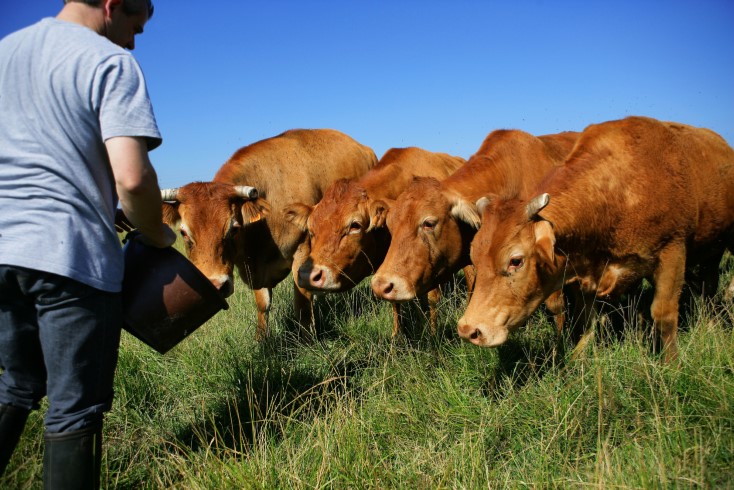
Cattle

Once they’re used to essential oils, animals can respond well to topical application.
  • For cats and dogs, paws are a great place to apply essential oils.
  • For hoofed animals, we recommend application on the spine or flanks.
  • Try rubbing oils onto your own hands and then stroking the animal’s fur.
  • For large or hard-to-reach areas, combine essential oils with V-6 Vegetable Oil Complex or water in a spray bottle for easier application.
  • Animal Scents Ointment can be used to seal and protect areas where essential oils have been applied topically.

Essential oils can be administered internally.
  • Some essential oils can be mixed with your animal’s food.
  • For large animals, you can pull out the bottom lip and drop oils directly into the mouth.

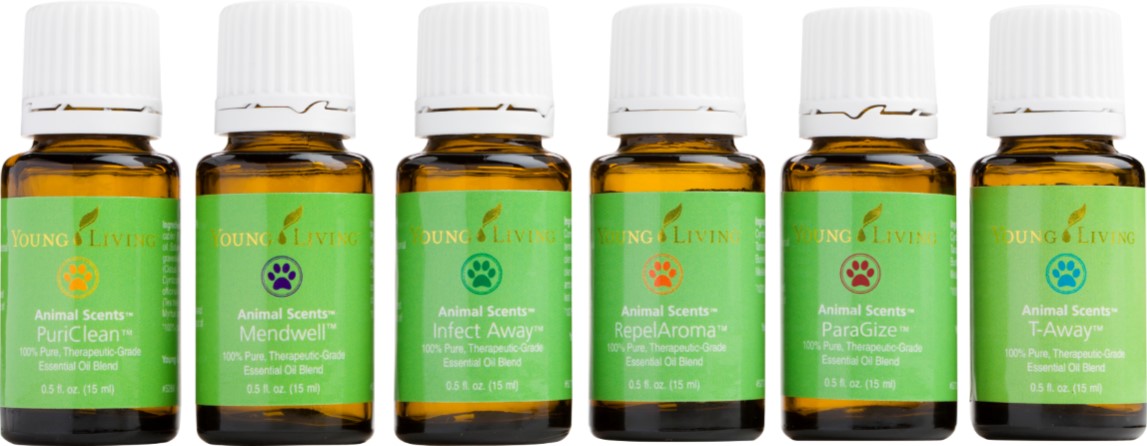
Young Living offers a full line of animal-specific products.

AnimalScents Oils - Young Living

*If your pet or animal has a known health issue, please consult your veterinarian before administering essential oils.

Get started on your amazing essential oils journey at:


Saturday, June 7, 2014

Essential Oils for Cats


Cats present their own unique controversies and requirements to essential oil use.  Most cat owners would agree that cats have distinct opinions of the world in which they allow us to co-exist, and this certainly holds true for aromatherapy. Cats are likely very proud of the fact that they are indeed the most contested topic in the world of essential oil use.  Human viewpoints of this subject range from the adamant stance that essential oils cannot be used safely for cats, to those who use contraindicated essential oils on a daily basis for their felines.

Essential oils for cats (and other animals) is a highly controversial topic, however it really is an argument that boils down to the quality of the essential oils.  Rest assured that ALL of the oils we recommend for use on your animals have been tested for safety and effectiveness prior to us recommending them to you.  The one factor that we stress is to ONLY use therapeutic grade essential oils, and the only one we recommend is Young Living Essential Oils, as they are tried and true for more than 20 years.

Cats are sensitive to most synthetically made products and "natural products" as well as someessential oils . . . . even if we are not aware of it!  We bring this up as many of us have sensitivities to food, household cleaners, hair and skin products, etc., however we may not recognize it because most of us are just not that tuned into our bodies and our environment. We may only recognize a change when we cease using certain products or stop eating a particular food item.

Have you ever considered the toxicity to your pets when you bomb your home with synthetic air fresheners, household cleaners or carpet cleaners?  Our pets have extremely sensitive noses and much smaller lungs, so subjecting them to breathing in chemicals and other toxic substances can do a lot of damage.

Many health problems today for humans, as well as for pets, can be traced back to toxicity within their environment, whether it's diet, personal care, or household products. 

Thankfully, there is something we can do about it!  Make a commitment to using non-toxic, holistic cleaning supplies, as well as diffusing healthy essential oils in your home and workplace for yourself and for your pets. 

Essential oils are the perfect solution for us and for our animals. Essential oils can replace most toxic medications for cats, dogs, birds, horses and any other living creature.  There are some oils that we cannot use on certain animals, cats included, so please do be careful and please ask us for guidance if you are not sure.  It is better to be safe than sorry, and the reason Healing Oils for Animals exists is to educate folks on the proper usage of essential oils for their pets, as well as for themselves.

Some of the best essential oils for cats include Lavender, Oregano, Thieves and Peace & Calming, however there are many other oils and nutritional products that are also quite effective!  Remember to always use therapeutic grade essential oils from a trusted source, such as Young Living.  There IS a difference, as demonstrated in the graph below.  


Please contact us for more information on Essential Oils for Animals, 
as well as Essential Oils for You!


Tuesday, February 4, 2014

The Loss of a Pet ~ Dealing With Grief

Part of the privilege of sharing our lives with pets (or fur kids) is the emotional bond we share with them. Even among these relationships, often there is one very special companion animal, whether a dog, cat, bird or even a reptile, who leaves an indelible mark on our lives.

When we are faced with the loss of any fur kid, much less a truly exceptional companion, we may be surprised to find ourselves suffering from agonizing grief. Some people worry over the intensity of their feeling, doubting their right to grieve so acutely. Rest assured, beloved furry, feathery or scaly companions ARE NOT ‘just animals’. This sentiment, shared by some who have chosen not to share their lives with pets, belittles your experience, so give it the credence it deserves … none.

Companion animals occupy special places in our hearts, and losing such a connection means that no one will ever fill that special place in quite the same way again.

Grieving the loss of a pet is normal, because the loss is real, and it hurts. Pets are family!  If you are in the midst of bereavement, we want you to know three important things:

1. Grief is a natural and normal reaction to the loss of a friend, including those with paws, tails, fur, feathers, beaks, scales, hooves, etc.

2. Grief affects everyone differently, so however you choose to grieve, it isn't "the wrong way".

3. A multitude of web and print resources address this issue and may help you cope during this difficult time.


The most vital thing is to open yourself to grace and give yourself permission to react to loss, whatever feels most natural to you. People have unique grief experiences, which is to say, the individual members of a family may have varying reaction to the loss of the same companion animal. Normal reactions to grief include deep sadness, feelings of hopelessness, crying, denial, numbness and anger.

The many stages of grief are well-established, however be aware that the progression is not necessarily linear ~ i.e., they can occur before, during and after the loss of the beloved. Sadness can last quite some time, even many months, but with proper attention to yourself, you will recover. While the pain may recede with time, these feelings are a legacy, a reminder of the importance of the role they played in your lives.

Losing a companion animal is devastating.  And yet, many pet parents don’t receive the kind of emotional support they might expect if they had lost a human family member.  Failing to show such a depth of compassion is common for those who have never shared a special bond with a companion animal.  These people might say to themselves, “What’s the big deal … it was just a pet.”  What they don’t understand is a very simple truth … losing a companion animal is losing a member of your family.

Anytime we suffer a dramatic loss, it is appropriate to grieve.  Your first priority should be to come to grips with the fact that it is perfectly acceptable to grieve the passing of your companion animal.  Accepting the magnitude of your loss can facilitate the process of grieving.  The more you fight to suppress your feelings, the worse your grief can become.  Hiding the heartache will do you no good.

Grief takes many forms, whether it’s denial, anger, bargaining, depression and ultimately, acceptance.  While many tout the different characterizations of grief as if they were absolute stages, these steps should be interpreted more as a continuum of emotion.  That is, some may not experience them and others may experience many simultaneously.

Some find the process of grief frustrating, as it is a process of reaction.  We may ask ourselves, “What can I do to feel better?”  Those who have experienced a recent loss should take some comfort in knowing that there are outlets for this impulse.  There are several organizations that allow you to contribute funds in the memory of your companion animal.  Many of these groups will publish an announcement of your gift along with a special message of tribute.  In this way, you can create a legacy for your companion animal.

Additionally, you should be certain to actively take care of yourself physically.  Because grief takes a toll on us physically, you should allow yourself extra time to sleep, be sure to exercise and eat well.

Don't be tempted to navigate your grief alone. If you feel like you don’t have the proper support to help process the loss of a companion animal, please seek out help from the following list of ‘pre-approved’ sources.  Don’t arbitrarily assign time limits to your grief.  The bottom line is ~ as with most emotional processes ~ it takes as long as it takes.  Above all, know that you are not alone in your experience.  Be sure to talk to other pet parents about your loss, but be sure to spend time sharing memories about the best times you spent with your companion animal, too.

If you’ve recently lost a constant and dear companion, we truly hope you’ll be able to deal effectively with your loss and find solace in the happy times you shared.  And, don't be afraid to reach out for help from the trusted sources listed below.  


Resources:

ASPCA Pet Loss Support Hotline
1-877-474-3310
http://www.aspca.org/pet-care/pet-loss

University of Illinois College of Veterinary Medicine CARE Pet Loss Support Hotline
1-877-394-2273

Michigan State University College of Veterinary Medicine Pet Loss Support Hotline
517-432-2696

Cornell University Pet Loss Support Hotline
607-253-3932

Tufts University Pet Loss Support Hotline
508-839-7966

Pet loss support website:
http://www.petloss.com

Argus Institute Colorado State University
http://csu-cvmbs.colostate.edu/vth/diagnostic-and-support/argus/Pages/default.aspx

*  *  *  *  *  *  *  *  *  *  *

Raven is an engaging entrepreneur who encourages others to celebrate pets as part of the family, as well as keep them happy, healthy, and spoiled with her online specialty pet boutique (http://www.TheGiftedPet.com), and premium pet food business (http://www.PremiumPetFoodStore.com)


For more information, please visit her Facebook page to PM her (https://www.facebook.com/TheGiftedPet), or email her at Raven@TheGiftedPet.com